In Spain, you only have to follow the sound of bells, the murmur of water or the bustle of a pavement terrace to find yourself in a town square, almost without meaning to. Because in our country, squares are the setting for history, encounters, celebrations and everyday life. There are medieval and baroque squares, Renaissance squares, solemn squares and bohemian squares. And all of them, absolutely all of them, have something that makes each of them special.
We could write an endless list, but today we suggest a plan: to visit some of the most spectacular squares in Spain, pause to admire their details and discover what makes them unique. Although, of course, we know that many are missing. Which ones would you add?
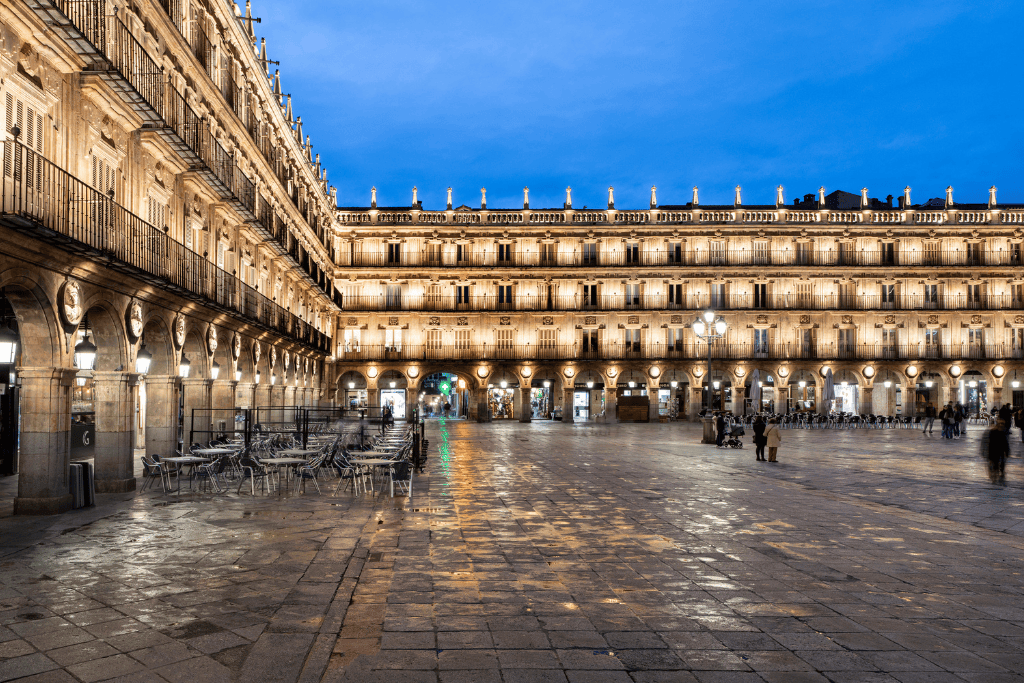
Golden sunset in the Plaza Mayor in Salamanca
Built between 1729 and 1755, the Plaza Mayor in Salamanca is one of the great Baroque ensembles in Europe and the true heart of the city. Its irregular layout, "astonishingly harmonious" in the words of Unamuno, features a succession of three-storey porticoed buildings that embrace the space and turn it into a monumental setting presided over by the Town Hall. It is worth taking a stroll and looking up at the medallions decorating the façades, which depict kings, military figures, writers and other illustrious figures, transforming the walk into an open-air history lesson.
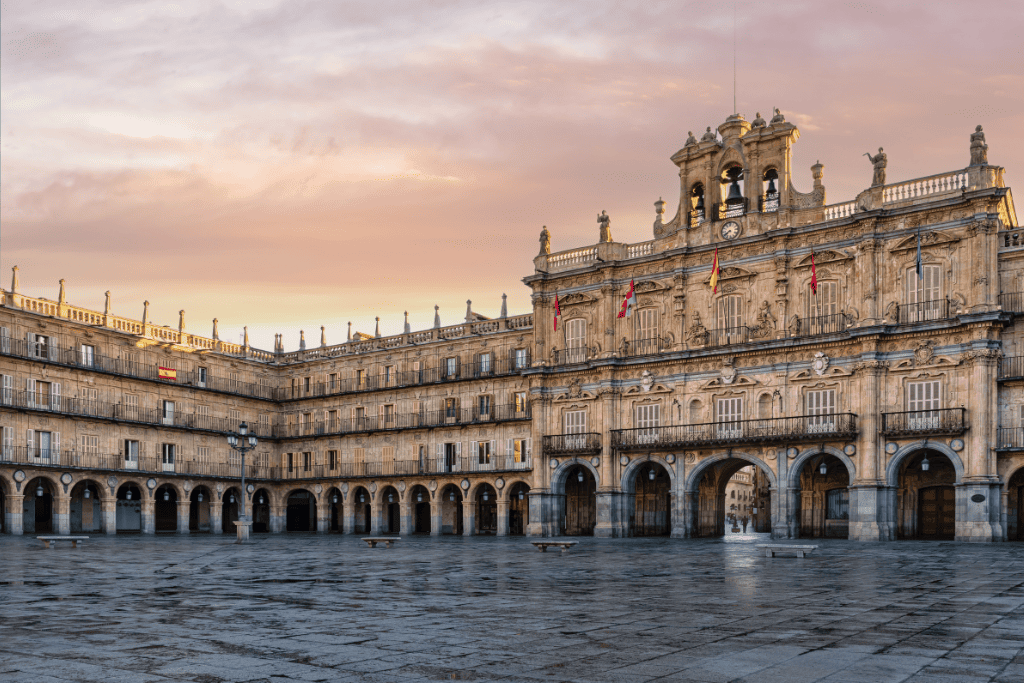
As evening falls, the Villamayor stone glows in golden tones and the square reaches one of its finest moments. Here, the usual thing to do is to "meet under the clock", find a pavement terrace and let the conversation flow.
And when you've finished exploring it, Salamanca continues. Just a few steps away, the historic University of Salamanca, the imposing Salamanca Cathedral, the unique Casa de las Conchas, the majestic Convent of San Esteban, the thousand-year-old Roman Bridge of Salamanca and the elegant Monterrey Palace await you. A city that is alive all year round, with its university, culture and gastronomy.
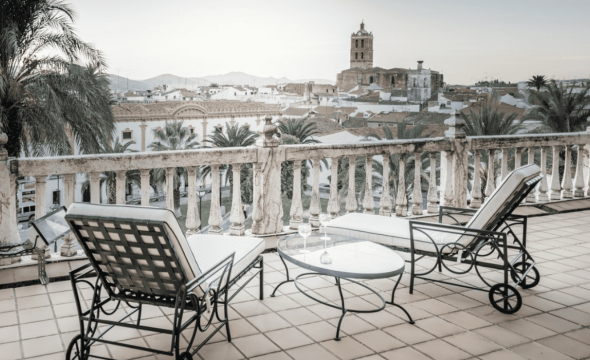
The city also boasts the Parador de Salamanca which offers one of the most beautiful views of the historic quarter. It is a place from which to gaze at the city, savour its cuisine and, if you wish, stay and rest after a long day of sightseeing.
Boat ride in the Plaza de España in Seville
Part of María Luisa Park, Plaza de España in Seville was designed by local architect Aníbal González as an emblematic space for the 1929 Ibero-American Exposition. It has a total area of 50,000 square metres, and a 515-metre-long navigable canal runs along its entire perimeter. Its imposing semicircular building symbolises an embrace towards America and is flanked by two towers that dominate the complex, and tiled benches dedicated to each Spanish province. The done thing is find your province and take a photo.
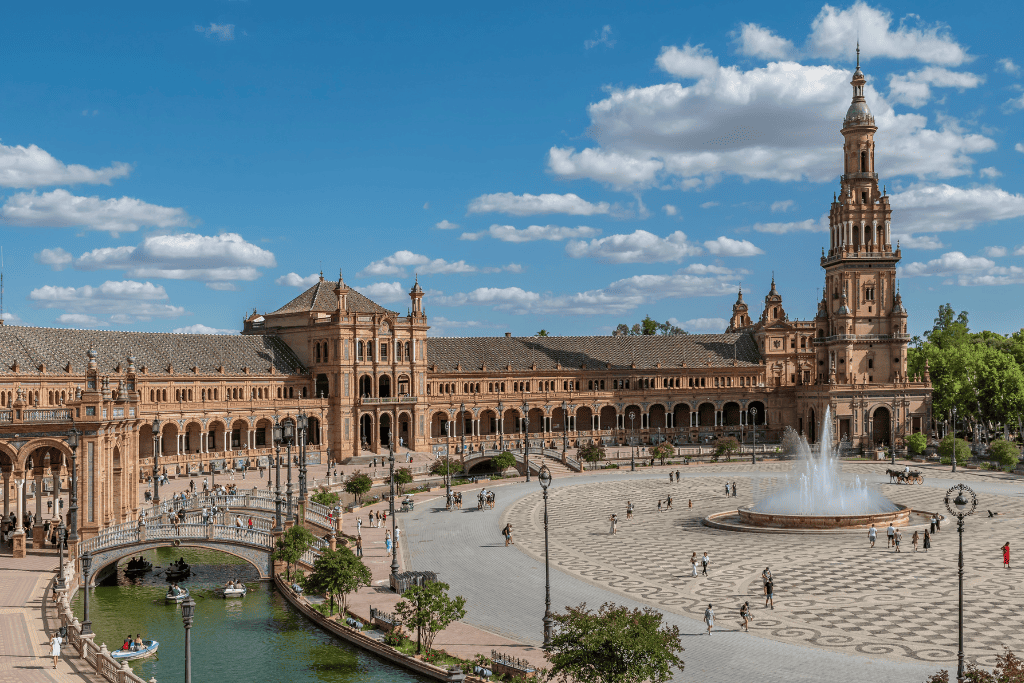
The surrounding gardens, which form part of María Luisa Park, are full of fountains, centuries-old trees and recreational areas that invite you to relax and enjoy the open air after visiting the monument.
And if you want to continue enjoying the area’s historical legacy, stay at the Parador de Carmona which stands on the ruins of a 14th-century Arab fortress and pays homage to the splendour of Al-Andalus with exquisite Mudejar decoration and spaces steeped in history.
Living history in Madrid's Plaza Mayor
With more than four centuries of history, this porticoed square was built on the site of the old market in the Plaza del Arrabal and was commissioned by King Philip II. Over the centuries it has been the scene of coronations, popular festivities, markets, bullfights and celebrations of all kinds.
In the centre stands the equestrian statue of Philip III. On one side is the Casa de la Panadería, with its striking murals, and on the other is the Casa de la Carnicería. After several fires, the most serious of which occurred in 1790, the architect Juan de Villanueva gave it its current, more sober and uniform appearance.
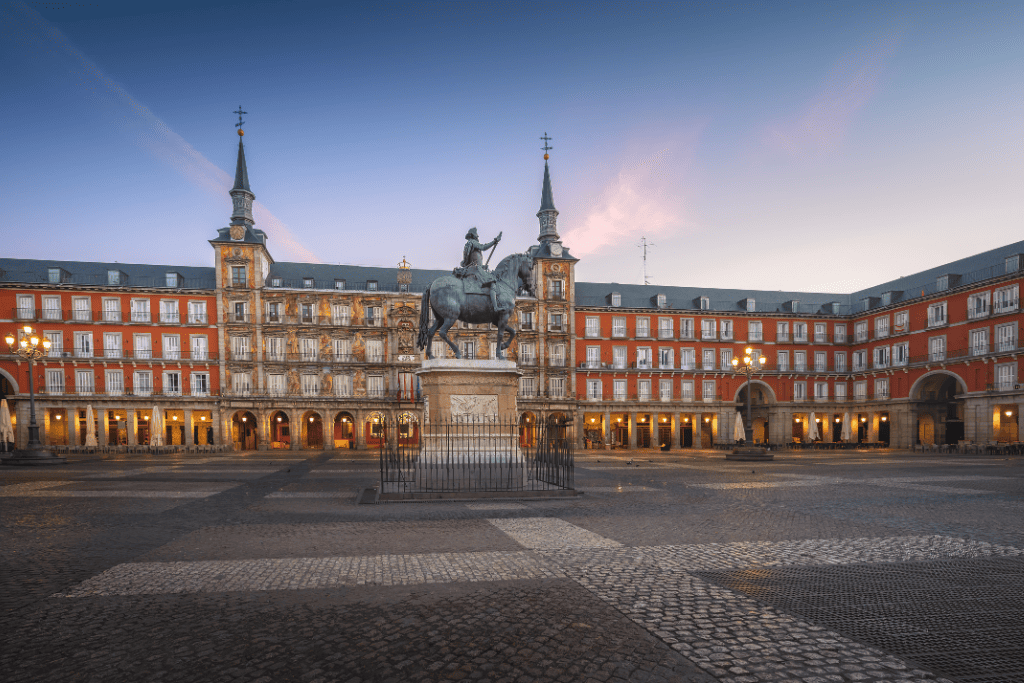
Today, Madrid's Plaza Mayor remains one of the capital's major meeting points and the epicentre of the Madrid de los Austrias. It is a monumental setting that combines history and everyday life, where curious travellers and traditional Madrileños coexist, keeping alive the tradition of gathering under the arcades to enjoy the classic squid sandwich.
If you prefer to stay away from the hustle and bustle of the city centre without going too far out of town, the Parador de Alcalá de Henares is an excellent option. Just 20 minutes away by public transport, it occupies a masterfully restored 17th-century school-convent, where historical heritage and contemporary design coexist with elegance. It will also allow you to discover Alcalá de Henares at your leisure, stroll through its historic centre and enjoy a more relaxed and authentic tapas experience.
Echoes of the Renaissance in the Plaza Mayor of Trujillo
In Trujillo, the square is space, stone and memory. Between the 15th and 16th centuries, noble families built Renaissance palaces here with coats of arms that still dominate the space today. In the centre, the equestrian statue of Francisco Pizarro recalls the city's role in the history of America.
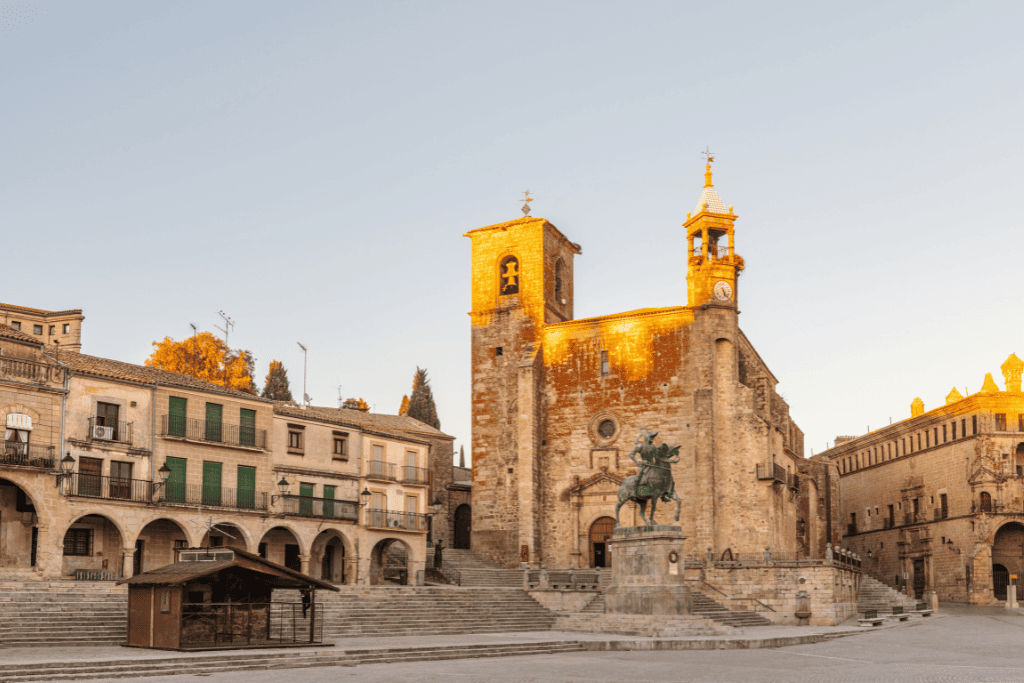
The Plaza Mayor in Trujillo offers visitors the outline of the church of San Martín, Renaissance palaces with coats of arms and arcades that today play host to pavement terraces and restaurants. Everything invites you to stroll around, look up to discover coats of arms and corner balconies, and pause to savour Extremaduran cuisine in a monumental setting.
And to prolong that feeling, there is nothing like staying at the Parador de Trujillo, housed in a former convent. Sleeping within its centuries-old walls is the best way to experience the city from within and continue to assimilate its past even after night falls.
Tradition and water in the Plaza de la Virgen
In the heart of Valencia lies the Plaza de la Virgen (known in the Valencian language as Plaça de la Mare de Déu and, formerly, also as Plaça de la Seu or Plaza de la Catedral), one of the most beautiful and emblematic squares in the city. It occupies the site of the ancient Roman forum and is surrounded by three important buildings: the imposing Cathedral of Santa María, the Basilica of Nuestra Señora de los Desamparados (Our Lady of the Forsaken) and the Palace of the Generalitat. Every year, during the Fallas festival, the square is filled with colour and excitement with the massive offering of flowers to its patron saint, Our Lady of the Forsaken.
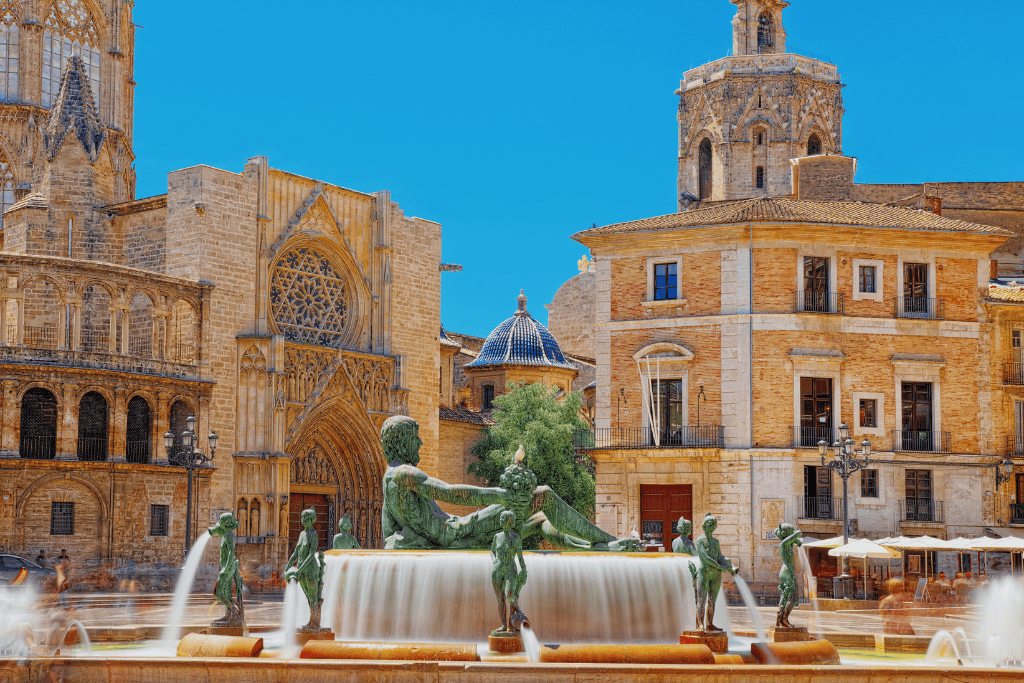
In the centre, the Turia fountain brings freshness to the ensemble with its allegorical figures representing the eight irrigation channels that water the Valencian groves and orchards. Among the buildings surrounding it, the Casa Vestuario stands out, a former stately home from 1800, now the Carles Ros municipal library. Its lobby surprises with a spectacular modernist staircase leading to a room decorated with frescoes by Vicente López. This house was also the meeting place for the eight members of the famous Water Tribunal, which still holds its public hearings every Thursday at 12 noon in front of the Apostles' door of the Cathedral.
To extend your Valencian experience and enjoy a well-deserved rest, there is nothing like staying at the Parador de El Saler, located between the Mediterranean and the Albufera freshwater lagoon. This Parador combines heritage, nature and gastronomy in a unique setting, ideal for relaxing after exploring the city.
Bohemian atmosphere in Barcelona's Plaza Real
Built in the mid-19th century on the site of a former convent, Barcelona's Plaza Real was conceived as the main square of the new Barcelona. Rectangular in shape and surrounded by elegant porticoed buildings, it combines classicism and urban vitality on every corner.
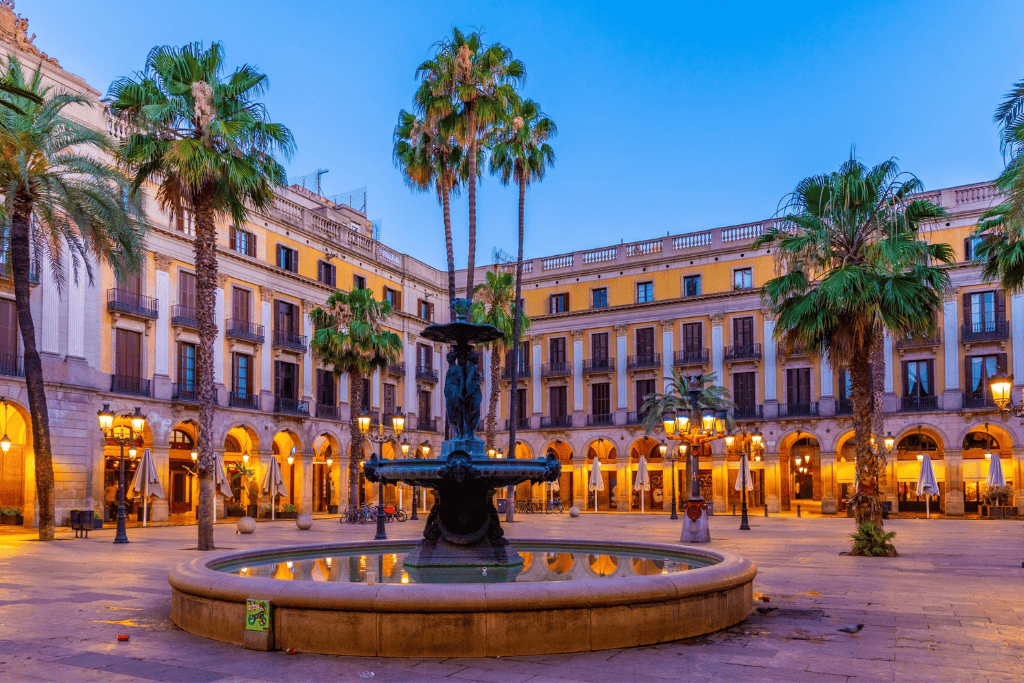
In the centre, the fountain of the Three Graces catches everyone's eye, while on either side stand two lampposts designed by a young Antoni Gaudí in 1879. Palm trees add an exotic touch and, under the arcades, life flows between restaurants, bars and vintage establishments that invite you to sit down and enjoy the atmosphere.
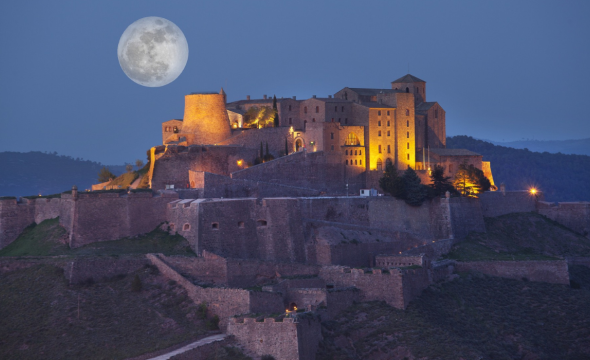
If you want to extend your getaway with a different experience in Catalonia, the Parador de Cardona is a unique option. Staying in a medieval castle with panoramic views of the Catalan landscape, walking along its centuries-old walls and immersing yourself in centuries of history makes any trip a different and unforgettable experience, perfect to combine with a visit to bustling Barcelona.