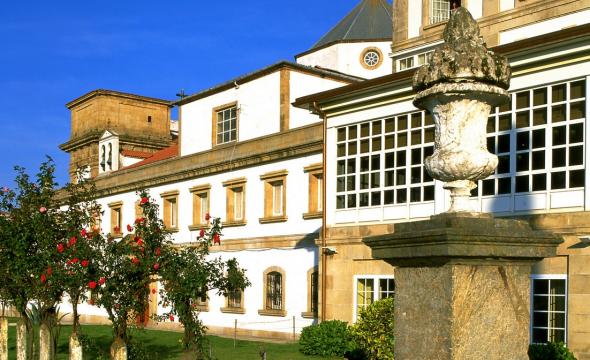
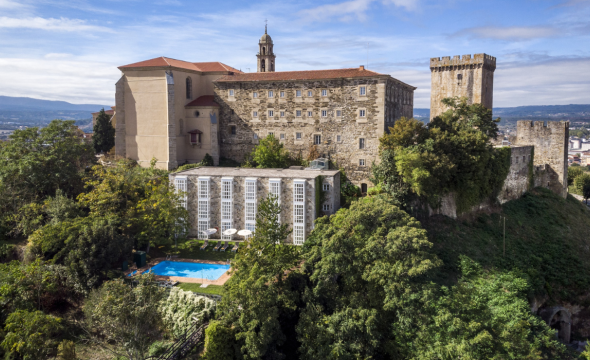
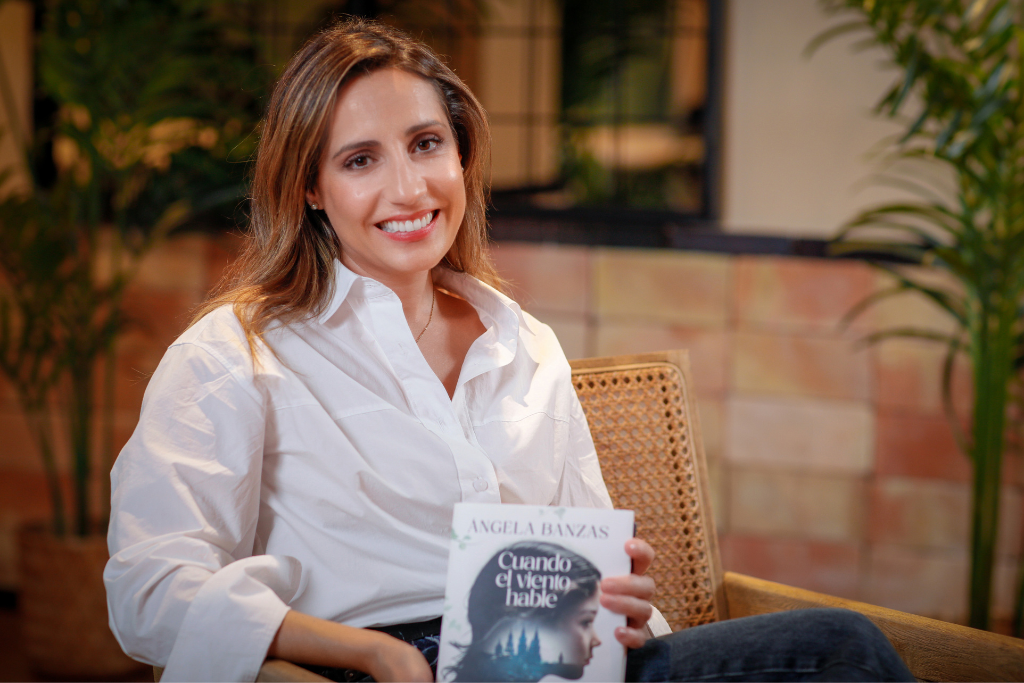
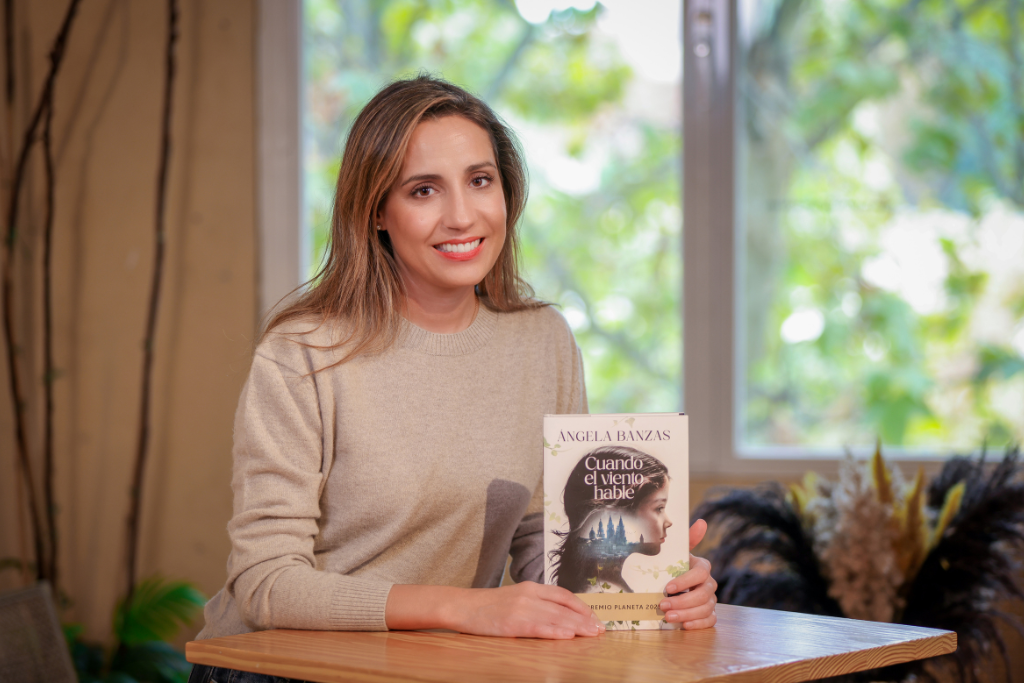
The finalist in the latest Planeta Prize, Ángela Banzas, has crafted a novel that offers a welcome respite from so much grim news. *When the Wind Speaks*, set in the building now occupied by the Parador de los Reyes Católicos – a former hospital until 1954 – explores the power of imagination in the face of horror, and love as our last hope. The comforting conclusion it offers is simple: a great story can always save our lives.
Being a finalist for the Planeta Prize is a huge boost for any author. Do you see it as a boost to your career?
I’d like to think so. It’s an incredible platform to propel me forward and reach more readers who will discover this work and, if they like it, continue to delve into my other stories.
*When the Wind Speaks* is set in post-civil war Galicia. As a Galician yourself, what does your homeland bring to the table when it comes to crafting stories?
I always set my stories in Galicia because my emotions are deeply rooted in my homeland. I craft stories with a profound psychological and emotional depth. I can only understand this when I’m rooted in Galicia. Moreover, it adds so much to the setting. This allows me to offer the reader a sensory immersion through my homeland.
Your novel stems from a personal childhood experience: a stay in hospital. How do you remember that difficult learning experience?
It was something I needed to work through in some way. I remember with great poignancy discovering that children can die. In my case, it was a scare, but there were other girls and teenagers who weren’t as lucky as me, either because of a fatal diagnosis or because they were hospitalised for their entire lives. Even so, they were still children. It was one of those terrible truths we have to face.
How does that experience become literature rather than trauma?
That was my aim: to convey a message of hope. Hospitals are one of the places where I have found the most hope. Some arrive, others leave, but they all wait with their eyes fixed on the windows as if they were a promise of the future. Hope, understood as a flame in a very long night, is a beautiful word. That was the message I wanted to convey: after the darkness, that flame remains.
You are one of those who firmly believe that, in the end, the clouds always clear…
I consider myself a hopeful person. That doesn’t mean I’m an optimist. I believe that everything has a meaning. I look out of the window and, if it’s raining, I enjoy that rain. There is an order in everything, understood as a driving force and an impulse.
You’ve said that you specifically wanted to write a very luminous book set against such a harsh backdrop as the post-civil war period. How did you balance the darkness and the optimism?
Hope is born of despair; it cannot be understood any other way. It cannot be born in the light. I wanted to explore that context because I wanted to show the perspective of individual and collective memory, that of the historical era itself.

You alternate the voice of your protagonist, Sofía, in the first person with other sections narrated in the third person.
Sofía offers us that more emotional perspective and allows us to connect with her innocence. At the same time, she is very lucid in her observations. The sections narrated in the third person—Daniel’s sections—offer a broader perspective to explain the story’s various plotlines.
Love plays a very powerful role in your novel. Why did you want it to be so present and linked to hope?
Hope is what gives life its meaning. It gives us that blind faith that life has meaning. I find that answer in love: it is what makes us feel alive in a human sense. It is that driving force that lifts us up.
Do we need good love stories more than ever before?
We have always needed good love stories. Every moment in history suffers from a certain lack of love and, even so, continues to place its faith in this emotion. The evil of our time is the isolation resulting from overwork and the pursuit of social prosperity. Technology doesn’t help either: it brings us closer, but, in a deeper sense, it separates us.
Are we still marked by the efforts of those generations that followed the Civil War?
Sadly, our memory is fading among the younger generation. When we know history, we give ourselves the chance not to repeat certain mistakes. It is all very well to focus on letting the wounds heal. To do that, we need to know where they are, where they begin and where they end.
In times as tense as these, can literature be a refuge for readers?
In fact, I believe it is. I see literature as an escape and a refuge. It allows us to live a thousand lives that we could not otherwise experience. There will always be a phrase to take comfort in and a place to travel to in our minds. I trust in the power of literature, both at its deepest levels and as a simple escape.
Speaking of good refuges, do you have a favourite Parador? Given that you’re as Galician as they come, I’d bet you’d choose one in Galicia…
Given that this novel is set in what is now the Parador de Santiago, I’d say that’s my favourite. It used to be the Royal Hospital, built by the Catholic Monarchs to accommodate pilgrims. I encourage everyone to visit it!