There was a time when lions roared, camels roamed, and a giraffe captivated ambassadors from across Europe within the walls of the Royal Palace of Olite. While contemporary courts vied to erect impregnable fortresses, King Charles III 'the Noble' transformed his Navarrese seat into an extraordinary domain, where gardens, pageantry, exotic fauna, and architecture converged to conjure an environment designed to instil wonder.
Six centuries later, that captivating world is being resurrected—not with wild beasts or creatures from far-flung lands, but through the medium of contemporary art. The recent reopening of the Parador de Olite-Erriberri breathes new life into this largely forgotten chapter of medieval history, establishing it as the centerpiece of a curatorial project that invites visitors to contemplate the past through a contemporary lens.
A Parador Enshrined Within One of Medieval Europe’s Grandest Palaces
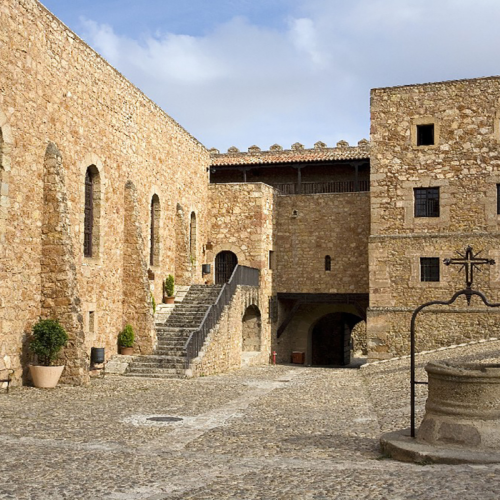
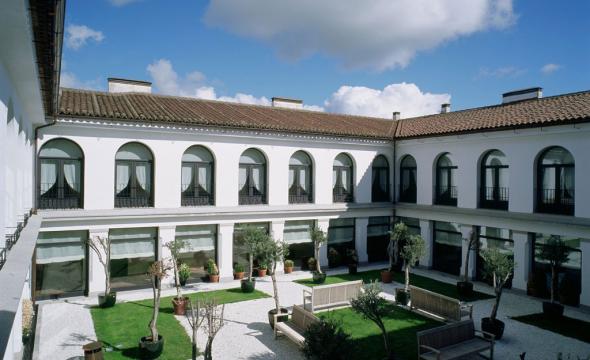
The Parador de Olite-Erriberri occupies the Palacio Viejo or Palacio de los Teobaldos, the most ancient quarter of the monumental complex comprising the Royal Palace of Olite. Together with the Palacio Nuevo, commissioned by Charles III, it stands as a masterpiece of European Gothic secular architecture, reflecting a court that ranked among the most sophisticated on the continent during the 14th and 15th centuries.

To pass the night within these walls is to inhabit a space that has borne witness to diplomatic receptions, banquets, courtly intrigues, and pageants—celebrations that cemented Olite’s reputation as one of the preeminent cultural epicentres of the Kingdom of Navarre.
A Restored Heritage Continuing Its Narrative
Following a closure of nearly twenty months, the Parador has reopened its doors after a comprehensive sympathetic restoration representing an investment of 8.6 million euros.

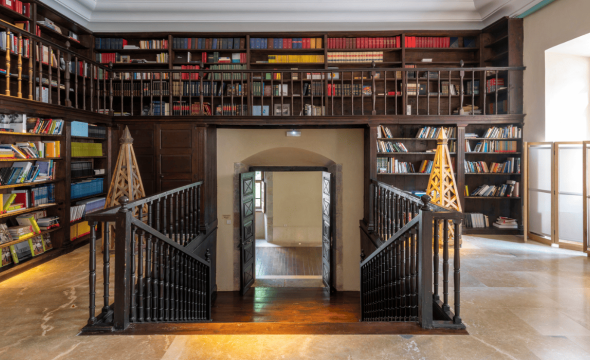
This meticulous refurbishment has thoroughly modernised the establishment while preserving its historical essence. The ancient masonry, the sweeping arches, the ancestral passageways, and the building’s vernacular features continue to guide the visitor's journey. They are now complemented by a contemporary interior design aesthetic inspired by the evocative palette of the Navarrese landscape: the terracotta tones of clay, the deep burgundy of the vineyards, the golden hues of honey, and the tactile warmth of timber.
Charles III 'the Noble' and the Menagerie That Captivated Europe
Towards the close of the 14th century, Charles III envisioned transforming Olite into far more than a mere royal residence. He sought to fashion a palace capable of rivalling the greatest European courts, turning it into a realm dedicated to pleasure, culture, and aesthetic marvel.
To this end, he commissioned hanging gardens, vaulted galleries, soaring towers, and halls adorned with a degree of opulence seldom seen across the Iberian Peninsula. Yet, there was one singular feature that rendered Olite truly exceptional: its menagerie.

Contemporary chronicles document the presence of lions, camels, buffalo, primates, exotic avifauna, and even a giraffe—a creature virtually unknown to medieval Europe. Arriving predominantly as diplomatic gifts from foreign monarchs, these animals served as the ultimate emblem of the Navarrese court's international prestige. To these was added a remarkable mechanical dragon deployed during courtly festivities, a testament to the medieval appetite for spectacle and theatricality.
This collection was far more than a mere assortment of animals; it was an overt statement of sovereignty, a display of wealth, and a window into a distant, uncharted world that only a privileged few were permitted to behold.
When Art Resurrects the Menagerie
This historical chronicle serves as the departure point for the new artistic project at the Parador de Olite-Erriberri. Rather than attempting a literal reconstruction of that menagerie, the exhibition poses a profound question: how do we perceive these animals today? What resonance does their historical presence possess six centuries later?

The works curated for the Parador respond through diverse artistic vocabularies. Painting and photography symbolically evoke the memory of those creatures to interrogate biodiversity, humanity’s enduring fascination with the exotic, the representation of nature, and our complex relationship with the animal kingdom.
Confronting the Animal Gaze
Estela de Castro’s photographs stem from her series Aves and The Animals, projects rooted in her profound commitment to animal advocacy.

Her portraits strip away all extraneous elements, leaving the viewer entirely alone with the animal and its gaze. No longer an exotic curiosity from a distant shore or a cipher for courtly power, the animal emerges as an individual with its own distinct identity, demanding to be observed with reverence.
At the Parador, these images strike a powerful juxtaposition with the history of the former collection: where there was once spectacle, there is now quiet introspection.
The Imagined Jungle
The monumental canvas Extraño Paraíso 10 greets visitors with a verdant jungle where reality and myth seem to coalesce.
Nacho Martín Silva constructs this landscape by drawing upon historical archives of taxidermy and the paintings of Henri Rousseau, the French artist who famously conjured lush tropical jungles without ever leaving Europe.

His work speaks of a nature constructed by human imagination—much like the Olite menagerie, which six hundred years ago served as a vessel for bringing a distant world into the heart of Navarre.
The Silence of After-Wonder
In stark contrast to Martín Silva’s exuberance, Manuel Vilariño offers profound silence. A National Photography Prize, his work Abada, invites the viewer to pause and reflect. His deeply poetic imagery places the animal in a realm where beauty, mystery, spirituality, and the inexorable passage of time coexist.

It is perhaps the piece that most elegantly encapsulates the ethos of the project: a space where, after the medieval spectacle fades, contemplation begins.
A Museum Inextricable From Its Setting
The most profound art collections are those that cannot be uprooted to any other location without surrendering part of their meaning.
Such is the case at the Parador de Olite-Erriberri. Each work derives its purpose from the very history of the architecture that houses it. The artists do not merely illustrate the past; they reinterpret it, crafting an invitation to discover that, behind the palace’s centuries-old masonry, the echoes still linger of a time when, over six hundred years ago, a giraffe could stroll through the court of the kings of Navarre.
Herein lies the true triumph of this Paradores Museum: demonstrating that heritage is not a static relic of the past. It remains a living entity every time a contemporary work successfully reawakens our capacity for wonder.