Since El tiempo entre costuras (The Time Between Seams) became the dream debut for any writer in 2009, María Dueñas has made each of her novels an eagerly awaited event for a huge community of readers. Her latest work, Por si un día volvemos (If We Ever Return), is no exception. Set in French Algeria, it demands attention from the very first page thanks to Cecilia, a protagonist with a soul of silk and steel.
If We Ever Return spans thirty years until 1962, with the exodus of the pieds-noirs from Algeria. What attracted you to that time and place?
In this novel, I focus on the last stage of French Algeria, covering a period of thirty-five years, from the late 1920s to independence in 1962. I set the action in Oran, a Mediterranean city very close to the south-eastern coast of the peninsula, with strong historical links to Spain. During the French period, thousands of Spanish immigrants arrived there thanks to job opportunities. The plot centres on the life of a Spanish woman, Cecilia Belmonte, during the last decades of that colonial era, years full of turmoil in a world where various social and cultural groups – Arabs, French, Spanish – coexisted in a society that was gradually breaking down. It is a little-known chapter in our history, despite the large Spanish community that always lived there.
The presence of Spaniards in Algeria portrayed in the novel takes us back to a time when emigration was common. How do you view this phenomenon today? Is this complex issue being treated too lightly?
I thought about this a lot while writing the novel. I thought, above all, about how we Spaniards have evolved, going in just a few decades from being a nation of emigrants to becoming a country that welcomes people from very different backgrounds.. Sometimes this situation becomes a complex problem. I don't know what the best solutions are, but we certainly need to remain sensitive to who we were not so long ago.
What were the Spaniards in Algeria like? Is there a story that particularly touched you?
Some – the minority – were businesspeople or professionals. Most were people from modest backgrounds who got ahead through determination and hard work. There are many powerful, admirable and moving stories... One of the best known is that of Albert Camus, whose mother was descended from humble Menorcan immigrants who settled in Algiers, the capital. From a very humble, almost poverty-stricken background, he ended up winning the Nobel Prize for Literature in 1957.
During the research phase, what were you looking for among the wealth of information available?
In all my novels, I use all kinds of documentation to reconstruct the worlds in which I set my plots. My aim is not only to recount what happened in those days and places in historical terms; I also seek to recreate atmospheres and bring that reality to life: its smells, colours, tastes, sounds, textures... I’m interested in knowing what the people who lived there at that time were like, how they spoke and dressed, who their neighbours were, what they ate and drank, what they read or listened to on the radio. What their homes, streets, neighbourhoods and businesses were like... Thanks to all these details, I am able to create settings that allow readers to immerse themselves in the atmosphere of each novel with the greatest possible accuracy.

In your novels, women get ahead despite adversity. How would you define female courage? Do men and women face difficulties in different ways?
It is often a mixture of strength and vulnerability, something inherent in human beings and, perhaps more specifically, in the very essence of women. Overcoming obstacles and facing adversity, drawing strength from where we think there is none left, overcoming vulnerability and continuing to grow are realities that most women are accustomed to. This is what I transfer in an almost organic way to my characters. Sometimes they achieve their goals and come out on top or even triumph; other times they fall, break down and struggle to get back up. However, my characters almost always fight tooth and nail, never give up and never stop trying.
What is Cecilia like? What were you looking for when you were constructing her personality?
When we meet her in the first few pages, she is a young woman fleeing from an unintentional crime under the false identity of Cecilia Belmonte. Through her eyes, we travel through the last decades of French Algeria, from her arrival as a miserable, ignorant young woman prone to abuse, to her departure as a successful businesswoman. Throughout those years, we witness her growth as a person, meet her lovers, friends and business partners, share her desires and concerns, and see her make her way in the soap manufacturing and sales business, from its humble and clandestine beginnings to becoming an admirable woman.
Has your approach to storytelling changed since you ceased to be an unknown author with The Time Between Seams?
When I wrote my first novel, I was a university professor engaged in teaching and research full-time, scraping together hours each day to make progress on a novel that I didn't even know would be published. Now I devote myself entirely to writing and, after completing each work, I support it to present it to readers, the media, booksellers... In that sense, my literary activity is now much more professional and organised. I like to get going after finishing each novel, just as I appreciate retreating after a period of public activity to start a new book.
What do you think of the author as a media personality? Do you feel a responsibility towards the large community of readers who follow you?
The success of writers is very manageable, not at all overwhelming or uncomfortable, even less so for someone like me, who has little active presence on social media and stays out of public debates unrelated to my work. If someone approaches you, it is usually with respect; I feel completely at ease, grateful for the attention my novels attract from readers and without letting success weigh me down. Besides, it would be unfair to say that success doesn't also have some pleasant consequences: very gratifying recognition, the opportunity to participate in interesting activities and to meet very interesting people.
As a successful storyteller, are you apprehensive when you embark on a story? If so, how do you exorcise those fears?
No, I'm not apprehensive at all, quite the contrary. Each new project is exciting; a new world opens up before me in which I can immerse myself to build a universe, create captivating characters and compose a story with which I hope to seduce readers once again.
Are you familiar with the Paradores network? Do you have a favourite?
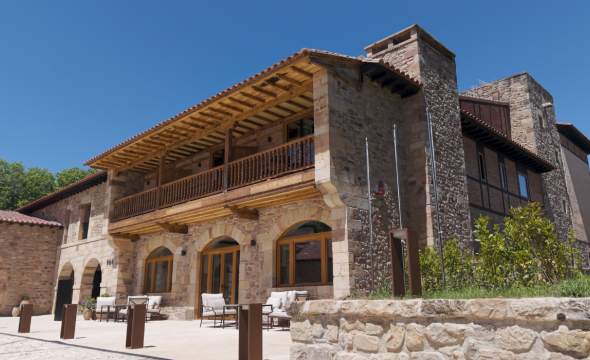
I know it and enjoy it whenever I can. My favourite is the one in Almagro; I had my wedding reception there, as did almost all of my siblings. This October, we will gather there again for a new celebration with my entire extended family.