He is one of Spain’s most internationally renowned photographers and is behind the latest Paradores advertising campaign, a project in which he brings his visual universe – somewhere between set design, painting and photography – to the online realm. His work, meticulously crafted yet open to surprise, engages with artistic tradition and champions emotion in an age dominated by immediacy.
You started out studying Fine Arts before turning to photography. Do you still see the world through a painter’s eyes?
Not anymore, though it was a struggle. I enrolled in Fine Arts thinking I was going to be a painter. I graduated in ’92, a time when photography had little artistic value. Now I approach painting for enjoyment, but I no longer see the world through it; fortunately, photography has undergone a sufficient artistic renaissance to change my perspective.
Where does that need to tell stories within a single image come from?
I started out doing photojournalism and then moved into fashion. There comes a point where, although the aesthetic aspect was interesting because you experiment to define styles and explore what the photographic medium offers, that runs out as a resource. That’s when the need arises to go beyond the aesthetic so that your work has meaning. You need to hold on to something other than aesthetics to decide whether a photograph I take is good or bad.
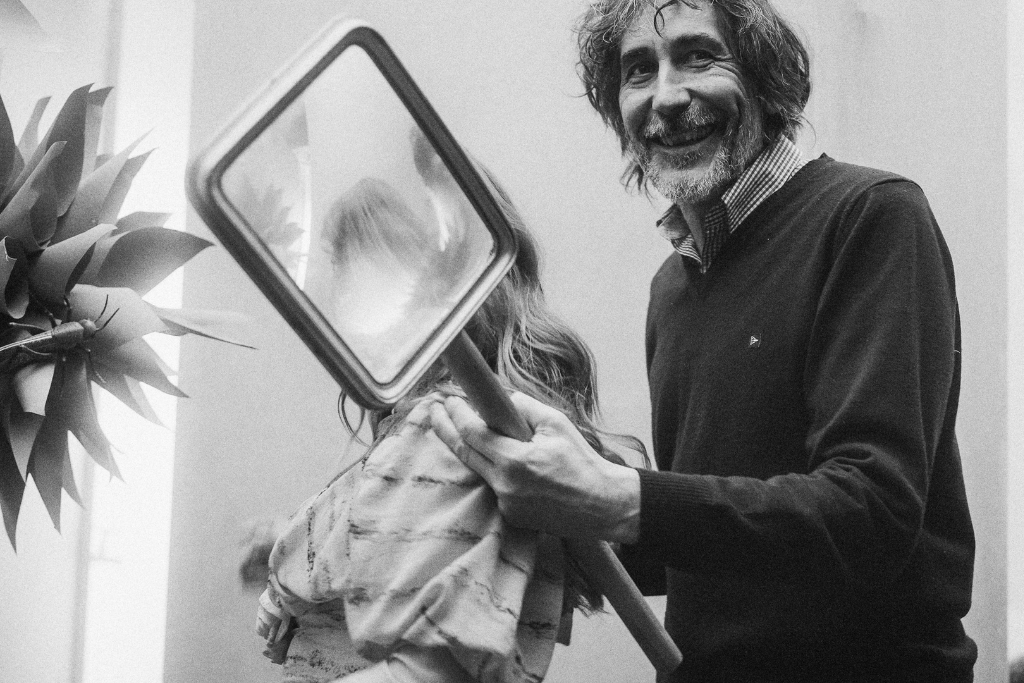
Some viewers of your photographs associate your aesthetic with the dreamlike. Like any artist, it’s only natural that you would disagree with your followers.
My photographs speak of what is happening around us. What happens is that, perhaps, I strip away the most literal elements so that they become more universal. That allows you to convey messages in a way that runs parallel to reality, whilst still taking it into account. At no point is there any reference to dreams, but rather to reality, albeit touched by that aesthetic heritage. When this aesthetic is used, it can be perceived as something dreamlike, that’s true. Reality is sorely lacking in poetry.
You’ve worked in fashion, advertising, personal projects… Where does your artistic spirit feel freest?
I try to be free in everything. I don’t pursue creative freedom so much, because sometimes I don’t know what to do with it. I need some guidelines to create. I like challenges: seeing whether I’m capable of making something out of a given starting point. That leads me to learn. In fact, I’m driven more by learning than by freedom. In the end, even if the work is a commercial commission, I always find something worthwhile for myself. Even in purely personal work, you can’t be completely free: you’re constrained by your capabilities, your desires, your upbringing… There are many things that limit us, even though we believe we’re in control of our decisions.
Your photographs are very constructed, almost choreographed. How much of this process is intuition and how much is control?
In my photography, there is a great deal of intuition at the moment the shot is taken, but there is a great deal of preparatory work. I do a lot of research and investigation. When I arrive at the shoot, I even forget to go over the documentation I have prepared, but everything I have studied gives me the opportunity to invent and improvise on a solid foundation. When you go to take the photograph, what you have learnt serves to set a direction and help you make decisions. At that moment, freedom is needed for magic to happen.
At a time when images are instant and ubiquitous, is that idea of photography a form of resistance?
It’s a way of thinking that I have a foundation which gives me the peace of mind that I’m on the right track. It’s what has taken me so far and what I hold on to. I sign contracts—with myself, and the justifications and failures too. I don’t need them to come from outside. That preparatory work means you know you’ve done things as well as possible. It’s a way of feeling at ease with what you do.
How does an artist like you cope with the ‘Instagramisation’ of the world?
Fine. It allows me to find inspiration. It’s one thing for horizons to open up, and quite another for that horizon to be the only one. The world is vast, and this allows you to see what’s being done out there; the problem is that it doesn’t allow you to delve too deeply into the images. The cycle we’re caught up in—of consuming and consuming—doesn’t let you engage with a second reading of the photographs. Modern life doesn’t make this easy. Images pile up and, in the end, you don’t really savour them. For my part, I try to ensure that the photographs I take look different every time you look at them.
Your images invite us to pause. Have we lost that way of looking, even when we travel?
We have lost the ability to be surprised. We want to know too much in advance, and when we arrive at places, we just want to confirm that what we’ve seen online is actually there. People are disappointed because they’ve already ‘visited’ the places before they even get there. Information kills knowledge, and knowledge kills wisdom. So much information robs us of our sense of wonder.
Paradores has made the transition from illustration to photography in its promotional campaigns, whilst maintaining that almost magical world. How have you approached that challenge through your own artistic language?
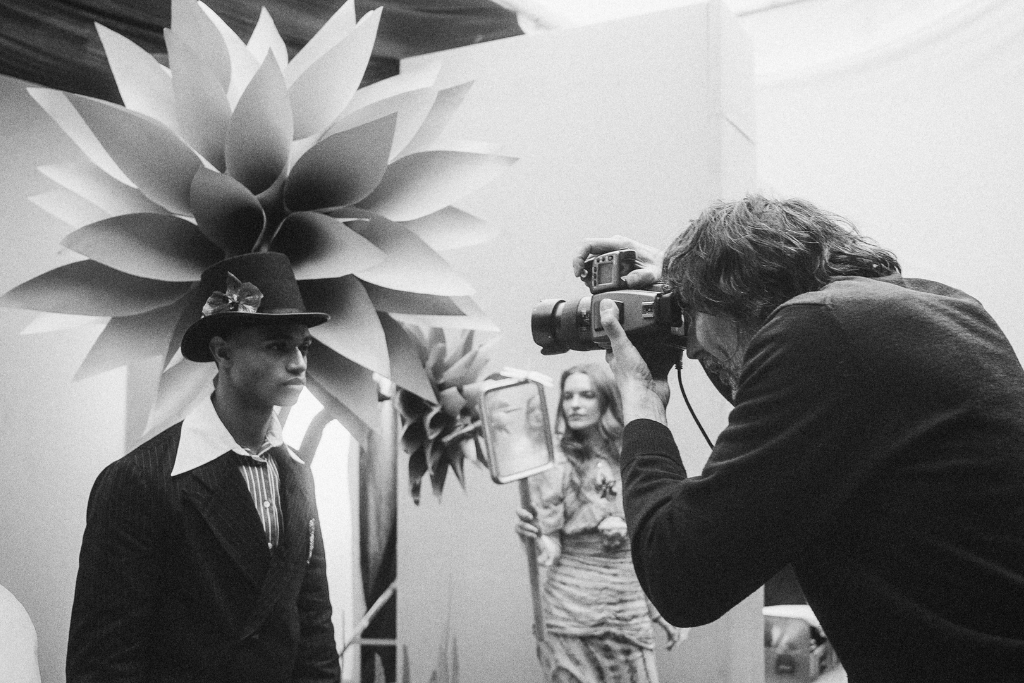
There is a part of my work that has a lot to do with illustration, coming from a Fine Arts background. I also draw inspiration from many children’s storybook illustrations, because they present fantastical worlds. It has been quite easy in that respect. To get as close as possible to a handcrafted look, we had the most striking elements – such as the flowers incorporated into the images – made by hand rather than using artificial intelligence. For example, we created cardboard plants to give a theatrical feel. When all the elements are handmade, the result resembles an illustration.
The campaign doesn’t so much show what Paradores is as what one can feel within that world. How do you photograph something as intangible as an emotion?
I’ve been trying to photograph emotions for some time. That manual aspect I mentioned makes it easier to convey them. By starting with surprise, you open up a space for the viewer to make it more human. From there, it’s easier to talk about emotions. The images are accompanied by a caption, which predisposes the viewer to feel. The emotion isn’t in the story you tell, but in how you tell it.
Speaking of feelings, what is your favourite Parador?
I know a lot of them, but almost all the ones I’ve visited are in inland Castile. Because it’s nearby, I’d say the one in Chinchón, which is the one I’ve been to most often. Whenever there’s a town with a Parador, I’ve always liked – whether I’m staying there or not – to pop in and feel part of the effort to save these buildings. Even if it’s just for a moment, you sense there’s a story behind them.