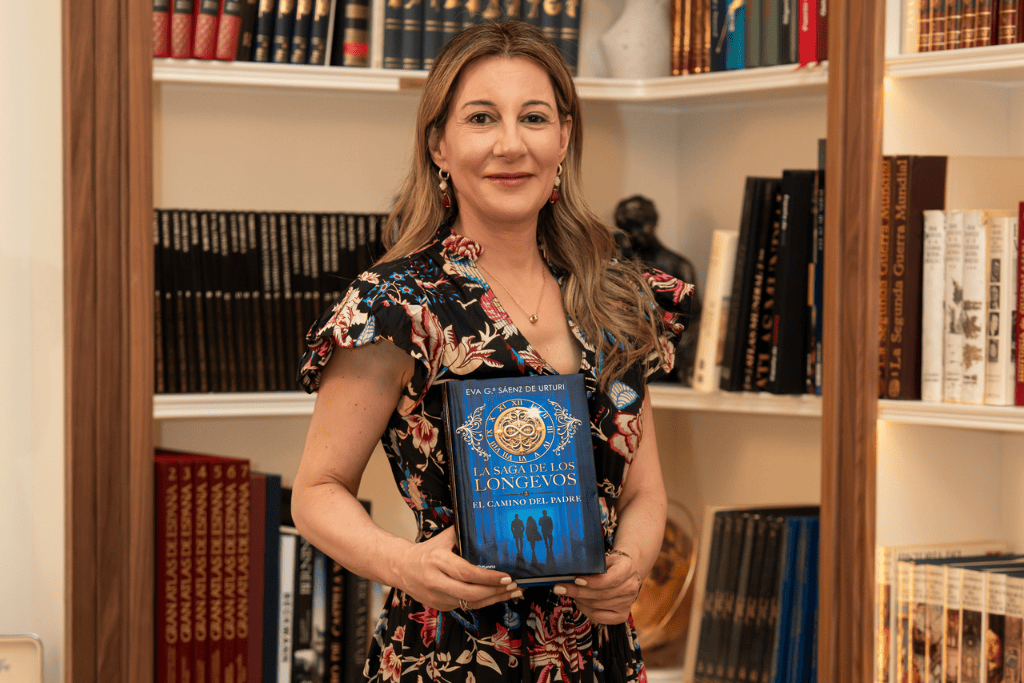
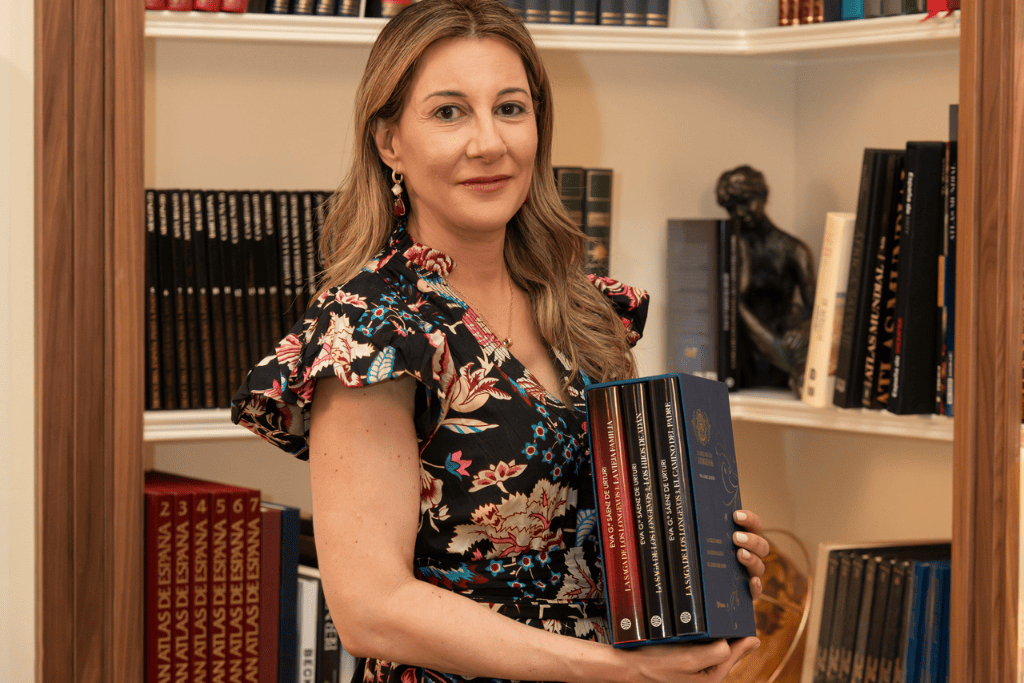
The readers' long wait has been rewarded. The Way of the Father is the last book in the trilogy of A Saga of the Ancient Family, a cult phenomenon that transcends fantasy literature. Eva García Saénz de Urturi explores universal questions such as longevity, memory and identity. Once again, the Alava-born author reaffirms her talent for constructing stories that tackle the great dilemmas of human beings.
Although over the years it has achieved outstanding literary successes; A Saga of the Ancient Family has always been there. How did you decide to take up the trilogy?
The reason for publishing the conclusion of the long-running trilogy was the insistence of thousands of readers over twelve years. It was incessant, and over time it went from strength to strength, to the point that on the internet the first print editions of A Saga of the Ancient Family and The Sons of Adam had become a cult phenomenon, selling for prices that were already around seven hundred euros.
Given what has been paid on the internet for the books in this saga, you have more fans than readers. is there a better compliment for a writer?
The best compliment is to be told that one of your novels has marked their lives, that it has become part of a turning point in their biography.
A Saga of the Ancient Family is undoubtedly a cult phenomenon. did this weigh on your mind when waiting for the response from the readers of The Way of the Father?
There is always pressure when you are a writer with four million readers and a Planeta Prize. In my case, I always compare it to elite athletes, in that they always have to be focused, lead a very focused and demanding life, and everything that comes from outside demands results and excellence. That said, in the solitude of the office, in front of the chapter I am going to write each day, I focus on the universe I am creating and on that microcosm where only my characters and I exist.
Although you had already defined the outlines of these works in 2014, did you have any doubts about your approach? Were you tempted to make changes when it came to finishing off the story?
The staggered scenes and the planning are the guidelines on which I will develop the chapters, but this structure allows me creativity and playfulness. When I rewrote the first and second parts in 2024, it was to be consistent with the writer I am now, with ten novels under my belt, and I wrote the third part between 2024 and 2025 with the narrative resources I have today, after sixteen years of the craft.
Your trilogy has given us characters such as Iago del Castillo and Adriana, but Nagorno is awe-inspiring. how did you construct these characters?
Building Nagorno took me six months at the time. I didn't want to redeem or justify him, but he was not an empty person per se; on the contrary, there was a lot of roar contained in there. Iago del Castillo was the projection of someone with great capacities and, moreover, with all the time in the world to develop them. As for Adriana, her journey starts with a loss she does not understand and ends with another loss that finds her when she is already aware of too many events of the past.
You did not want to forgive Nagorno. Do you believe in the possibility of redemption or are there cases where one has to throw in the towel?
I think forgiveness is overrated because we come from a culture in which the Christian religion has demanded it, leaving victims with the responsibility of reparation, even when there is no remorse or guilt, and forgiveness means putting the victim back in the same place so that the abuse or aggression continues indefinitely. It is not necessary to forgive or let go in order to move on: the memory of the wrong done by others is a logical defence of the brain, which only wants us to survive.
The idea of longevity is the basis of this trilogy that triumphs in an age when youth is a virtue in itself. Are we becoming too obsessed with erasing the passage of time?
The great social sin is ageing, especially for people with a public profile, and even more so for women, who are not forgiven, whether they do something about it or not. Ageism is the most idiotic form of discrimination, because those who scorn or criticise someone for having reached their birthday live in a fictitious reality in which they think that they will not age, or that it will be many years before it happens, or that they will take better care of themselves or have better genes and it will not be noticed; there is a false perception of eternal youth: then the calendar and reality arrive and they find themselves on the receiving end of bullying.
How do you cope with the passage of time? How to prepare the mind for serene ageing?
I love life and I love being alive; I already know myself very well and I give my body and mind all the self-care it needs: it's the only way.
Is there a humane way to make people understand the need to know history to explain the present?
We live in an age of immediacy and lack of judgement, of indifference towards the past, even that which happened only a few decades ago. There is a kind of every man for himself and the devil take the hindmost, as if we were not living in the time in history when we have had the most access to knowledge, free and in the palm of our hand.
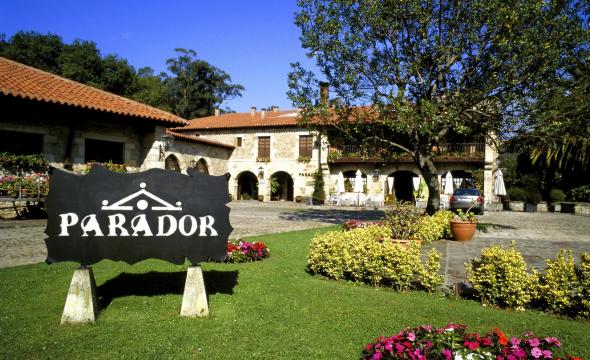
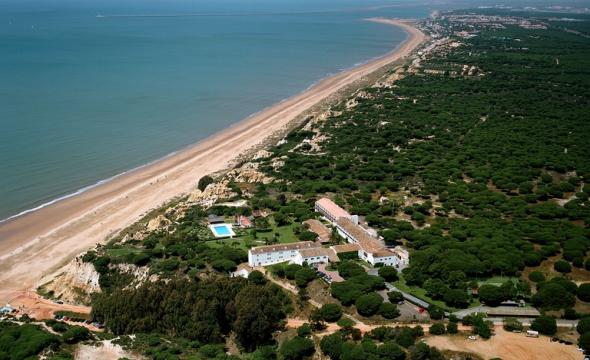
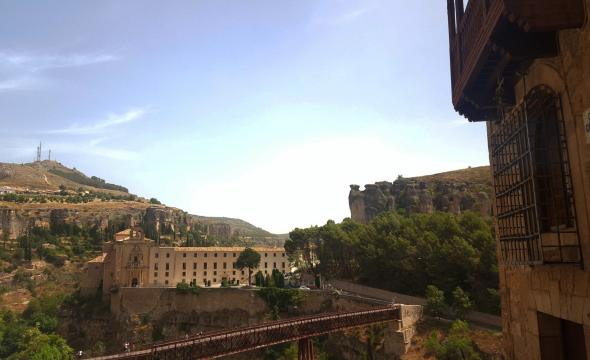
No doubt a lover of the past like yourself would enjoy the Paradores de Turismo. Any favourites?
The one in Benavente, in Zamora: the calm and peace on the Duero river are priceless, and the local food is a gift.